
Paul’s Third Missionary Journey

On his third missionary journey, Paul once again visited the churches he established in the first two journeys, but he also spent several years building a Christian community in Ephesus. This is Paul’s last major missionary journey before his final journey to Rome.
Modern-Day Türkiye
While Paul’s previous journey ended in Jerusalem, his third began back in Antioch after he traveled through modern-day Syria. From Antioch (modern-day Antakya), where Paul began each journey, he returned to Tarsus, Derbe (modern-day Kerti Höyük), Lystra (modern-day Zordula), Iconium (modern-day Konya), and Pisidian Antioch (modern-day Yalvac).
“After spending some time there [in Antioch] he departed and travelled through the Galatian country and Phrygia in turn, strengthening all the disciples” – Acts 18:23.
For details on the modern locations of these ancient cities and their archeological sites, read our previously published blog on Paul’s first missionary journey.
Ephesus

From there, Paul went to Ephesus, as he promised he would when returning from his second journey. Ephesus is in the modern Izmir province, on Türkiye’s west coast, and is a major Christian tourism destination due to its biblical significance and vast archaeological site. The famous ruins include the Temple of Artemis (one of the Seven Wonders of the Ancient World) and the Library of Celsus.
In Ephesus, Paul introduced disciples to the Holy Spirit and baptized them. “On hearing this they were baptized in the name of the Lord Jesus; and when Paul laid his hands on them, the Holy Spirit came upon them, and they began to speak in tongues and to prophesy. There were about twelve men in all” – Acts 19:5-7.

Paul preached in the synagogues for three months before many refused to believe and drove him out. He moved to conducting daily discussions in the lecture hall of Tyrannus for two years. During this time, Paul’s influence spread widely throughout the region as God performed extraordinary miracles through him, including healing people and casting out evil spirits.
“And many of those who believed kept coming, and openly confessed their practices. And many who had confessed magical arts collected their books and burnt them publicly; and they reckoned up the prices of them, and found the sum to be fifty thousand pieces of silver. Thus mightily did the word of the Lord spread and prevail” – Acts 19:18-20.
Paul also faced many conflicts, most notably with a silversmith named Demetrius, whose business of making silver shrines of Artemis suffered due to the rise of Christianity. This led to a large riot in the city – the mob eventually calmed, but Paul left Ephesus shortly after for Macedonia.
Modern-Day Greece

After the uproar in Ephesus, Paul departed and traveled through modern Macedonia (modern-day northern Greece), encouraging the believers converted in the previous journey in Beroea (modern-day Veria), Thessalonica (modern-day Thessaloniki), Philippi, and Corinth.
Each of these cities were discussed in more detail in our blog on Paul’s second missionary journey.
Return to Jerusalem
Paul then traveled back to modern-day Türkiye and arrived in Troas, where he preached late into the night in an upstairs room. During his sermon, a young man fell asleep and fell from a window to his death. Paul went down, embraced the man, and said, “Do not be alarmed, life is still in him” – Acts 20:10.
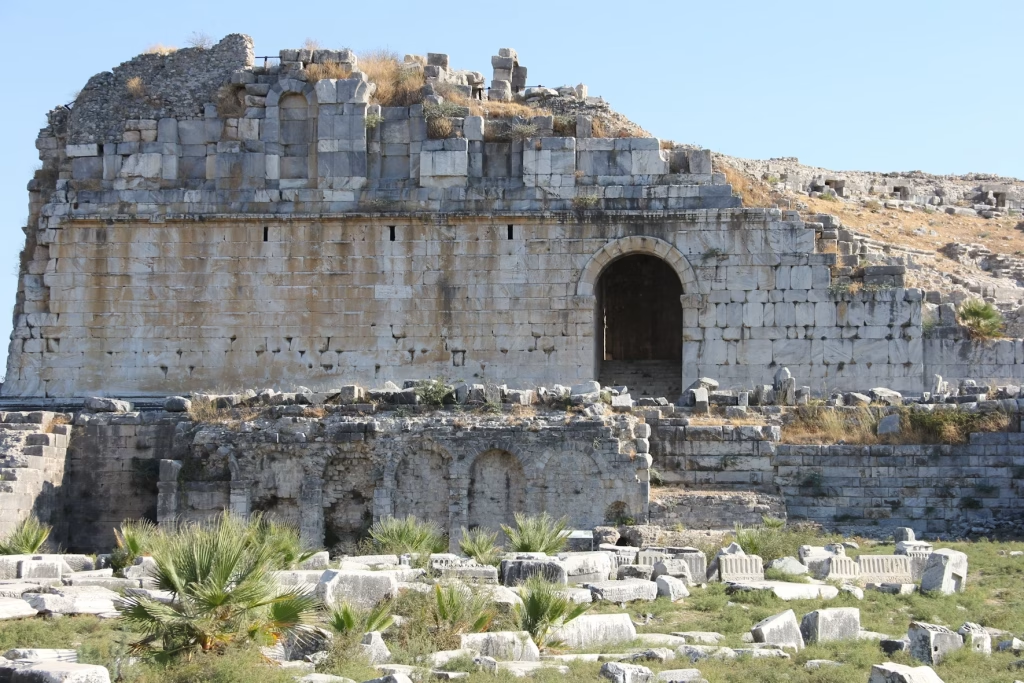
Paul then went to Miletus, skipping over Ephesus so he could reach Jerusalem faster. In Miletus, Paul called for the elders of the Ephesus church, offering a heartfelt farewell. He reminded them of his ministry: “serving the Lord with all humility and with tears and in trials that befell me because of the plots of the Jews; how I have kept back nothing that was for your good, but have declared it to you in public and from house to house” – Acts 20:19-20.
Miletus is located in the modern-day Aydin Province of Türkiye. Today, Miletus features an open-air museum. The main attraction is the Miletus theatre, used by Roman gladiators, where you can actually walk through underground passageways. Nearby, you can also visit the Priene ancient ruins.
Paul anticipated the difficulties ahead and warned the Ephesian leaders of false teachers: “I know that after my departure fierce wolves will get in among you, and will not spare the flock” – Acts 20:29. With great emotion, Paul told them that they would never see him again. The elders wept as they embraced Paul and prayed together (Acts 20:36-38).
Paul’s journey culminated with his return to Jerusalem. To get there, they sailed to Tyre (city in modern-day Lebanon), then traveled to Ptolemais and then Caesarea (both in Israel). Despite warnings from fellow believers and prophets about the dangers awaiting him in Jerusalem, Paul was determined to go. “I am ready not only to be bound but even to die at Jerusalem for the name of the Lord Jesus” – Acts 21:13. Paul was arrested in Jerusalem, which set the stage for his trials and eventual journey to Rome, which we will discuss in our next blog post.
Follow Paul’s Footsteps
We would love to help you follow in Paul’s footsteps and have the unique experience of exploring early Christianity and evangelism. You can visit all the key locations from his third missionary journey – in fact, Ephesus is among the most popular Christian tourist destinations.
Want to follow Paul’s footsteps, but don’t know where to start? Start with Greece! View our sample itinerary with air and ground packages starting at $2995/person! Ephesus and other Türkiye add-ons are available upon request.
Do you want to learn more about the historical and cultural context of Paul’s journeys, stand in the ruins of the places where he walked, and reflect on his dedication to spreading the gospel? Reach out to us to discuss your options or request a quote online.